Hello my friend, it’s nice to see you again.
Nice to see you V. What are we talking about today?
It’s been almost a year since we talked about the hierarchy of ambigrams. I would like to talk more about this, now that we’ve explored a third horizon, filter ambigrams.
(By the way, if you’re relatively new here, you can take a look at the chapter I’m talking about here.)
I’ll give you a quick review of what we’ve discussed so far.
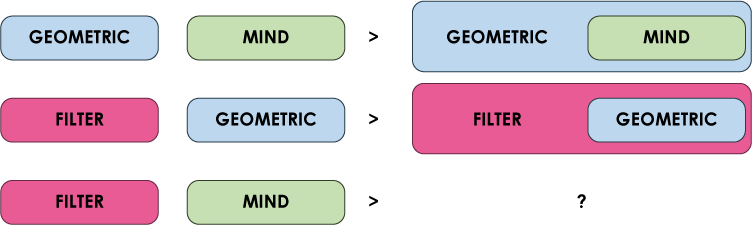
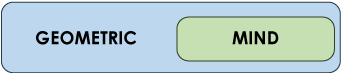
Ambigram categories fall into hierarchy. The mind category is the fundamental one, since mind ambigrams contain the elements that make ambigrams work. That is, they contain the most basic, primary and substantial tools of duality in reading. The geometric category builds upon the tools used in the mind category. Here’s the image we’ve used to display this relationship.
Let’s remind ourselves of the number hierarchy.
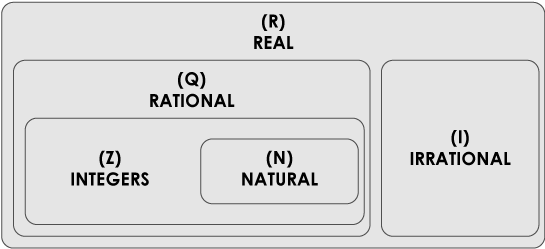
Natural numbers (N) are 1, 2, 3 etc. Those are the most basic, fundamental numbers that exist. Then integers (Z) build upon those, they introduce 0 and negatives, such as -1, -2, -3 etc. Rational numbers (Q) build upon integers, they are 1/2, 2/3, 1/4 etc. Each and every group above builds on the most basic ones. Only irrational numbers break the mold. But, let’s leave that aside for the moment.
The same rule applies in ambigram hierarchy as well. Mind ambigrams contain the fundamental tools of duality in reading. Geometric ambigrams build upon those, but also introduce geometric transformations as well.
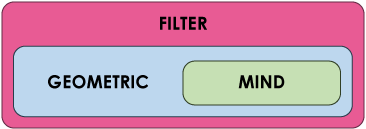
Now, the question is… where do filter ambigrams fall in this diagram?
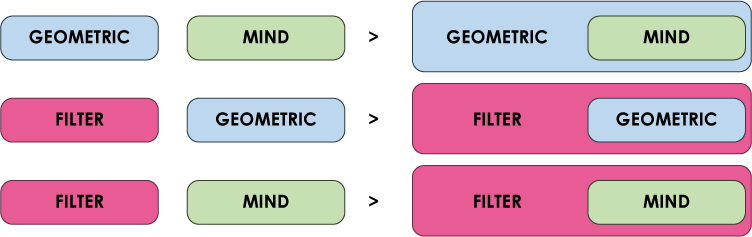
In order to find out, we must examine the relationship between filter-geometric and filter-mind ambigrams.
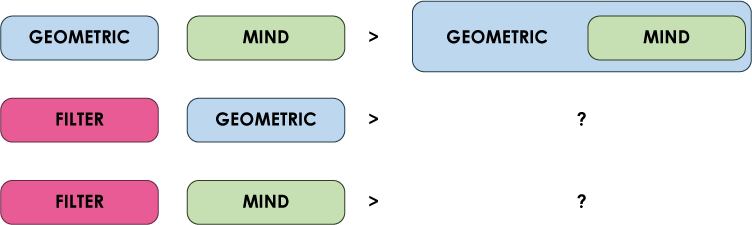
Actually, it would be wise to say that we should only examine the relationship between filter and geometric ambigrams. That’s because, if filter ambigrams contain geometric ones, then they must contain mind duality tools as well. But who knows? Maybe filter ambigrams are something like irrational numbers, totally unrelated. Let’s see…