Hello my friend, it’s been a long time that we’ve been exploring mind and filter ambigrams and I have a nostalgic feeling getting back to the basics. Let’s get into geometric ambigrams once more. I have some fascinating news about this category. If you read till the end, I have a special bonus for you. Shall we dive?


Hey Vassilis, sure, let’s go!


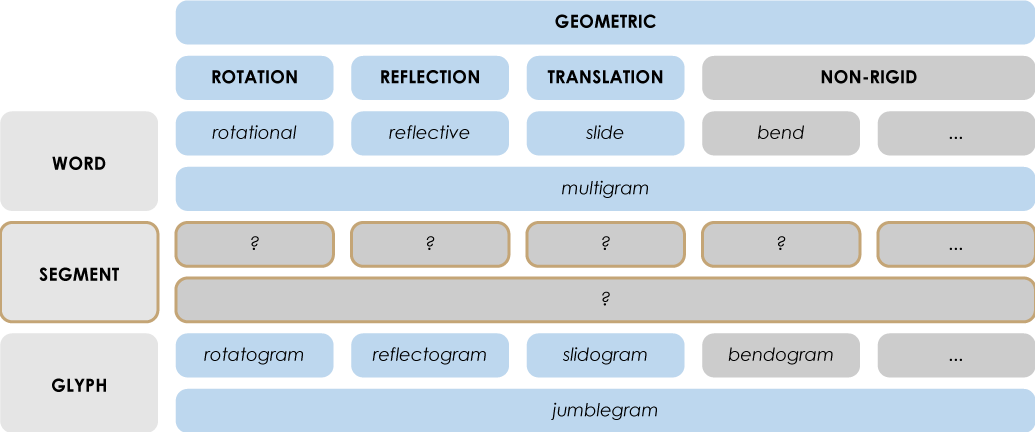
Let’s see where we’re left in the geometric ambigrams map.
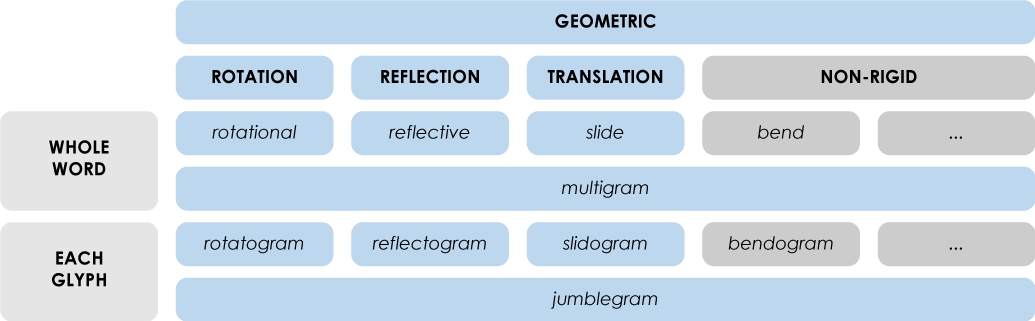


The table seems complete, right?


Apart from non-rigid transformations. Are we getting into those?


No, not today. Let’s look at the rest of the table. Does it seem complete?


I think so.


Well, I have good news. I think there’s more to it. Actually, there’s a lot more to it.


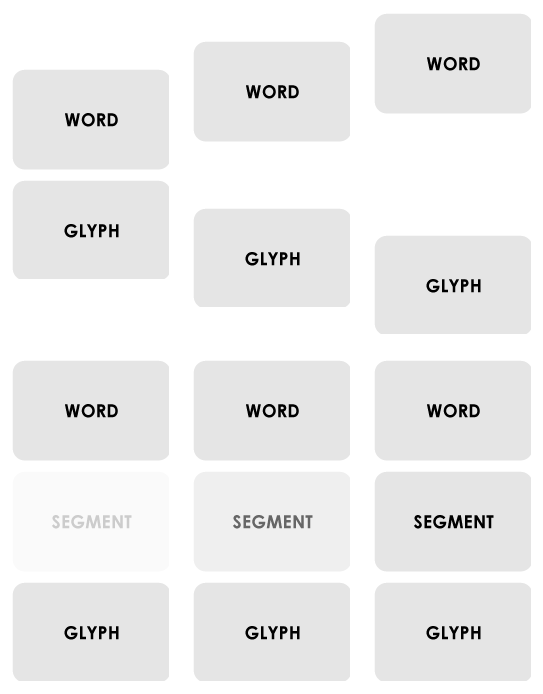
For now, let’s leave the transformations for a while and let’s focus on the units.
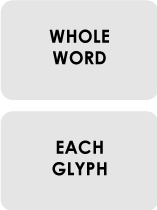


These are the units: the parts of the art that go through the transformation. Let’s take rotation for example.


Rotation in a word? Here you are, you’ve got a rotational ambigram.



Rotation in all glyphs separately? Here you go, that’s a rotatogram.
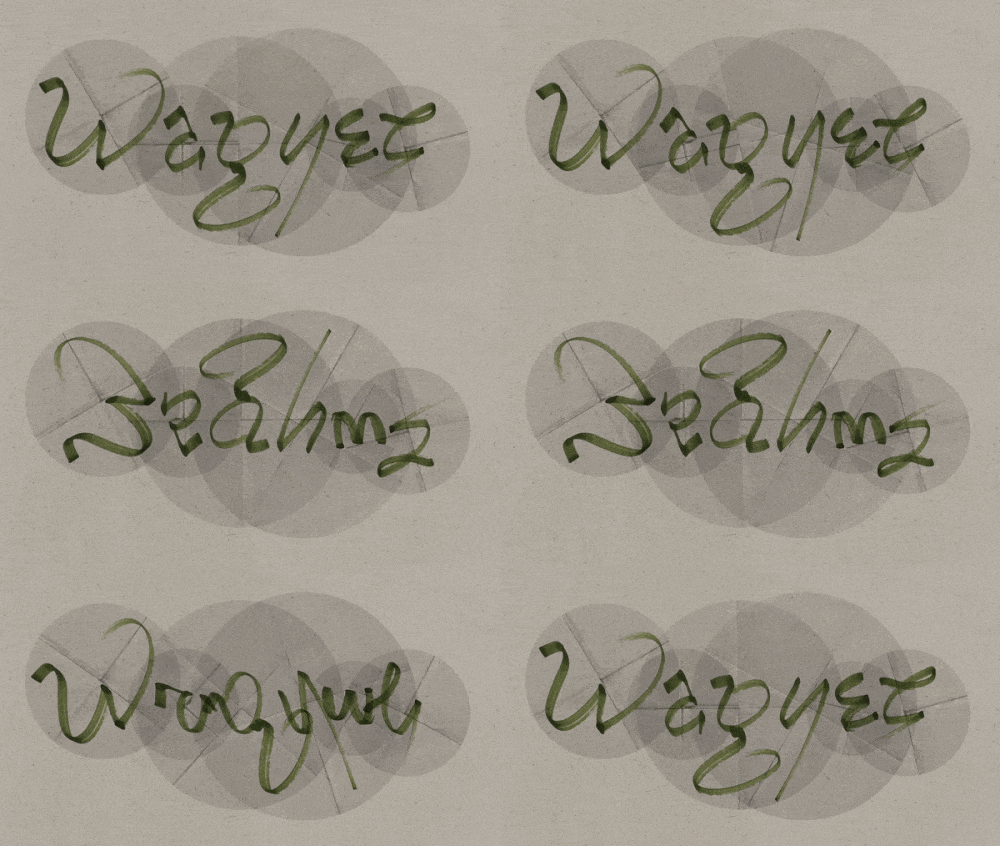


So, this is what this table says.


The rotation can apply to either the entire word or to each of the letters (or glyphs) at the same time. That’s why we consider the “wave” piece and the “wagner-brahms” piece to be of different ambigram types. They both use rotation, they’re both categorised as geometric ambigrams, they’re both under the rotation column, but they’re different.


Their core mechanism is the same, rotation. But they differ on the part that’s being transformed.


That’s why there’s a y-axis as well. And that’s the good news. Can you see it?


Hm… what do you mean? Is there more to the y-axis?


Oh yeah! Hear me out. In the following examples, I have the honour to present some ambigrams that Jeff Harrison has prepared for this chapter. In case you don’t know him he’s an amazing artist and his works have a certain flow that I find inspiring. Let’s look at piece of his.



It’s the word ‘united’. That’s a rotational ambigram. Rotation applied to the whole word.


But here’s the crazy part. I present to you…

   Segments   


Segments? What are they?


Well, what if we split the word into two segments? Like this, for example.


That’s a chain ambigram.


Yes it is. When artists cannot turn the whole word in a single ambigram, we tend to split them into segments. We usually call them chain ambigrams, since we can display them as a never-ending word, like this.


Or we can display them as a never-ending circle, like this.


The two segments in this ambigram are ‘un’ and ‘ited’. We repeat them many times, because if we used the rotated version of the ambigram, it would read ‘itedun’. So, we add a ‘un’ in one end so that we can read ‘united’ in that orientation. But this leads to an ‘unitedun’ in the other one. So we add an ‘ited’, and this goes on forever, resulting in a never-ending sequence of these two segments.


Well, I just said two segments.


Two…


But why not three? Like this for example.


Wow!


Oh yeah! You see, my friend, when you split the word into segments, it doesn’t have to be two. You can have three of them, four, or even more if the word lends itself to.


And you know what’s that? A new group inside geometric ambigrams!


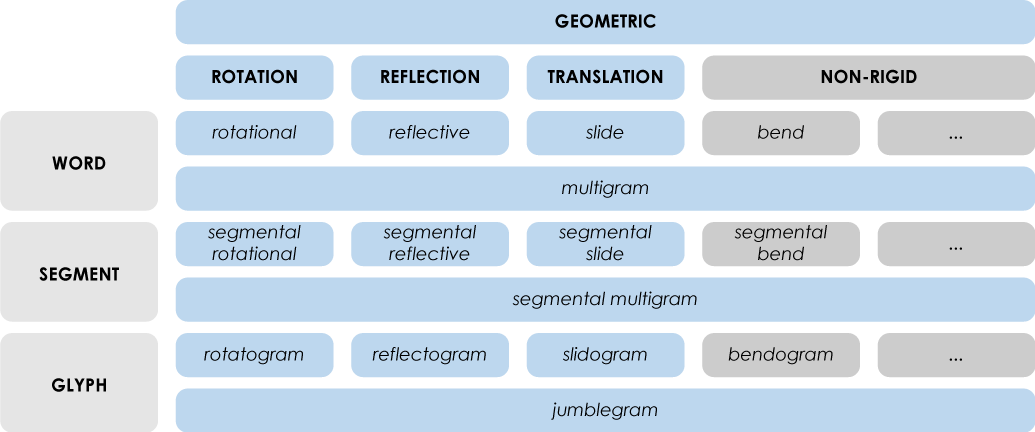
For simplification, I renamed the other units as ‘word’ and ‘glyph’.


So, there lies a whole new world for us to explore. Here’s the geometric ambigrams map, as of now.


   Naming   


I’m not good at naming things, but technically speaking, the geometric ambigram types are:


Word group

• word rotational ambigram
• word reflective ambigram
• word translation ambigram
• word multiple transformation ambigram

Segment group

• segmental rotational ambigram
• segmental reflective ambigram
• segmental translation ambigram
• segmental multiple transformation ambigram

Glyph group

• glyph rotational ambigram
• glyph reflective ambigram
• glyph translation ambigram
• glyph multiple transformation ambigram


But we like simplicity. We’re artists.


For the ‘word’ unit, we omit the ‘word’ word. We also named the ‘multiple transformation’ thing, as ‘multigram’.

For the ‘glyph’ gunit, we use other names, such as rotatogram, reflectogram and so on. I specially like the ingenious idea of naming the ‘glyph multiple transformation ambigrams’ as ‘jumblegrams’.

For the ‘segment’ unit, naming is yet to come. I have an idea naming those ‘rotatingram’, ‘reflectingram’, ‘slidingram’ and ‘jumblingram’, but I keep that for later. Maybe you, my friend, will come up with better names.

Until then, here are the names


Word group

• rotational ambigram
• reflective ambigram
• slidegram
• multigram

Segment group

• segmental rotational ambigram
• segmental reflective ambigram
• segmental slidegram
• segmental multigram

Glyph group

• rotatogram
• reflectogram
• slidogram
• jumblegram


Isn’t it a better idea to just call them ‘chain ambigrams’?


Until today, this is what we called them. But that’s wrong for many reasons. Here’s why.


1. First of all, up until now, we’ve been splitting words just in two segments. That’s the reason we could illustrate our ambigram as a ‘chain’. Chain is a display choice. You can show the same ambigram type in two ways. Either like this:

or like this


Whatever the illustration, the type is the same. Two segments of the word rotate independently. In the Bonus part I promised, we’ll meet a piece where the repetition is part of the design itself, not just a display choice.


2. Naming ‘segmental ambigrams’ as ‘chain’ is wrong, since a chain display doesn’t work for every segmental design. How can you display this one in a chain?

If anyone can come up with a way of a static display, a star for example, hooray, we found another way of displaying this. But this won’t be a ‘star ambigram’. Displaying as a ‘star’ or a ‘chain’ is a design choice, not the ambigram type per se.


3. You know what’s even crazier? Even when drawing two segments that rotate independently, you cannot name this as a ‘chain rotational ambigram’.


Why’s that, Vassilis?


Because rotational ambigrams, by definition, refer to the whole word being rotated. Here we have two parts rotating. Do you know how can you call them, if you still want to use the word ‘chain’?


How?


Chain segmental rotational ambigrams.


So, chain rotational ambigrams don’t exist?


Well, in order for them to exist, the whole word must rotate (not two segments) AND be a chain at the same time. Until we find one of this type, let’s take a look at the majority of the ‘chain’ ambigrams out there, which are segmental ambigrams, and which I find really appealing to the eye.

   Examples   


This is Metal Zealot’s “spare”. The segments are ‘sp’ and ‘are’.


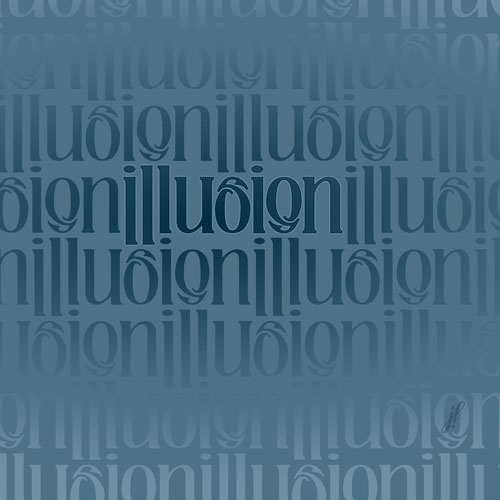
Here’s another one. It’s ‘illusion’ by Jennifer Lynch, aka FlippinIncredible. The segments are ‘ill’ and ‘usion’.


I like the natural letter pairs in the following one. It’s ‘sunscreen’ by Bryan Sanders. The segments are ‘suns’ and ‘creen’.


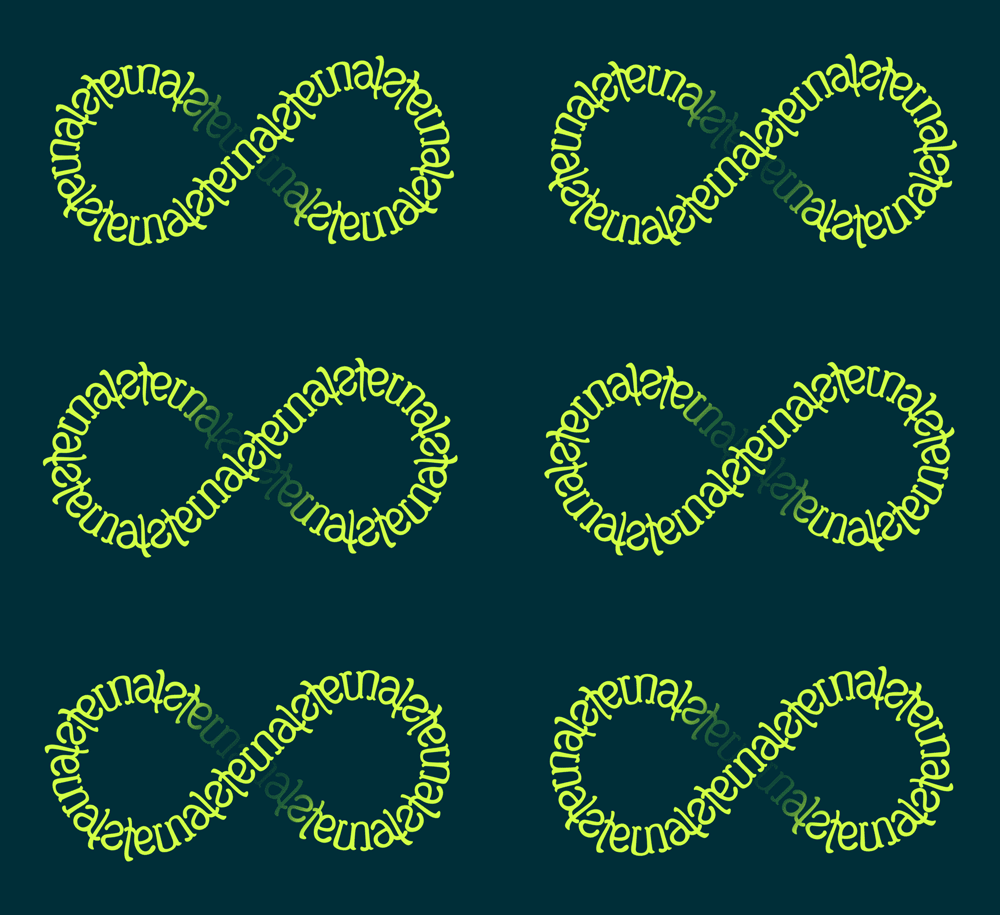
Bryan is an amazing artist and illustrator. He tackles off some amazing animations as well. Here’s another piece of his, called ‘eternal’. The segments are ‘e’ and ‘ternal’. The illustration in this fits the the theme perfectly.


The list goes on forever. These are segmental rotational ambigrams.


There are segmental reflective ambigrams as well.


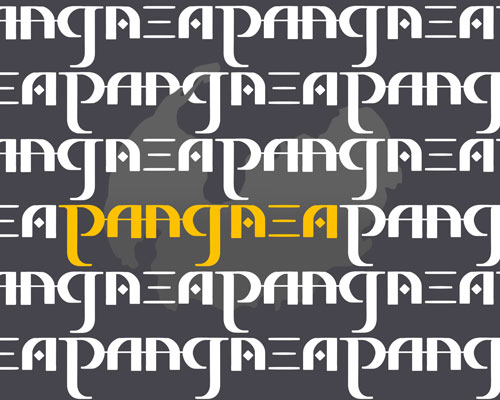
Here’s one that I find really interesting. It’s ‘pangaea’ by MelonSlice.


That’s a segmental reflective ambigram, using two segments, ‘pang’ and ‘aea’. An alternative illustration of this ambigram would be this.


I’m pretty sure there are more ‘chain’ segmental reflective ambigrams out there, but I cannot recall any. If you may, please remind me the artist and the piece, so that I can update the book version, when and if it eventually comes out.


As for the segmental translation ambigrams, I leave it for you to find out how they look.


But I promised you a bonus, didn’t I?

   Bonus   


All rotational chain ambigrams that we’ve seen are segmental ambigrams, since they’ve been split into two segments and they rotate on their own. The same applies to the reflective ones as well. Thus, they’re not chain rotational ambigrams. They’re chain segmental rotational ambigrams. But this leads to a question…


Are there chain rotational ambigrams?


And if they do exist, how do they look like? Let’s think of it.


First, in order to not be a segmental ambigram, but a ‘word’ rotational ambigram, the whole word must rotate. We cannot split the word into smaller parts, where each and every one rotates to its center.


Second, the word must repeat itself many times. More specifically, the design must only work as a repeating loop. We cannot just throw a normal rotational ambigram and copy-paste it some times. That doesn’t make it a ‘chain’.


Do you have any idea how anyone can achieve this, my dear fellow reader?


Hm… probably having the first letter of the word rotate to not the last one, but another one, and the letter widths do not allow for a split inside the word?


That’s right! I know you’re awesome. That’s why you read Ambigram Horizons after all.


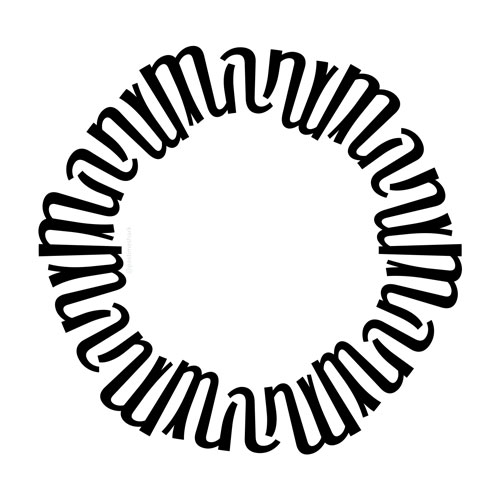
And that’s what pTshark has achieved with this piece, called ‘many’.


Look at it. Admire it. That’s not a segmental rotational ambigram. You cannot split the word into two halves. That’s a clean word rotational ambigram. As pTshark said, many words, but only one glyph. Notice that here, unlike in segmental ambigrams, the chain isn’t a display choice, but the repetition is build into the design itself.


And that’s the only chain rotational ambigram I’ve seen.


I don’t know if you share my enthusiasm, but this piece is simply amazing. Bravo pTshark!

That was amazing!


I agree. But hey! Let’s look at our table once again. Isn’t it beautiful?


What say you? Do we keep the descriptive names as they are, or do we also coin new ones, like ‘rotatingram’?


I need to think of it, V.


I’d be happy if you did, my friend. Until the next one, smile every everyday. And go create something. The world needs you!

Have you ever thought of chain ambigrams this way?


Drop a message into [email protected] so that you share your thought.